


The Port of Lobito, Angola –
the Atlantic terminus of a 1,300 km rail corridor from the Copperbelt
By: Shahab Mossavat
2 October 2026
For decades, the copper of Central Africa has gone to sea the long way round. Mined in the south of the Democratic Republic of Congo and in northern Zambia, it has travelled by lorry east to Dar es Salaam or south to Durban, across several borders and over journeys of around a month. The Atlantic was, to all practical purposes, out of reach.
That is no longer so. The Lobito Corridor – some 1,300 km of railway from the Copperbelt to the Angolan port of Lobito, along the line of the old Benguela railway – is carrying freight again. The first trial consignment of Congolese copper concentrate reached the coast in eight days. Operated under concession by a consortium of Trafigura, Mota-Engil and Vecturis, and backed by the European Union and the United States, it is among the most closely watched infrastructure projects on the continent.
More than a mineral line
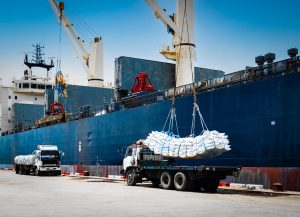
It would be easy to read this as a mining story. The more interesting question is what travels the other way. A railway that takes copper out can bring goods in: fertilisers, industrial chemicals, coatings raw materials, water treatment polymers and grain. These are the inputs on which farms and factories depend, and they can now reach inland markets faster and at a lower landed cost.
Predictability matters as much as speed. A manufacturer who can rely on a delivery date holds less stock, ties up less capital and can plan production with confidence. That is how a mineral route becomes an economy.
The governments concerned are insistent on the point. As Prime Minister Judith Suminwa Tuluka of the Democratic Republic of Congo has said:
“The Lobito Corridor must not be just an infrastructure project, but a real lever for economic transformation serving the people.”

The real prize is inbound –
the industrial and agricultural inputs that reach inland markets
The money is beginning to follow the argument. In August, the African Development Bank approved a $255 million loan and a $10 million grant for Zambia’s part in the corridor, including a new railway of about 500 km to join the Angolan line. The financing is tied to trade facilitation, agriculture and energy as well as to transport.
One coast, many doors
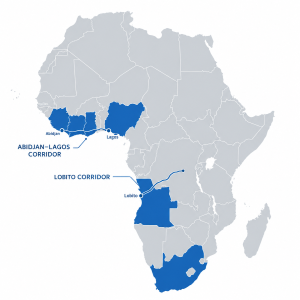
Nor is Lobito alone. Far to the north-west, five West African states – Côte d’Ivoire, Ghana, Togo, Benin and Nigeria – have agreed by treaty to build a six-lane highway of more than 1,000 km from Abidjan to Lagos, and to run it as a single supranational asset under its own authority. Costed at some $15 billion, the project has moved from technical studies to the investment stage.
Taken together, these projects describe something larger than any one route. The Atlantic seaboard – from Abidjan round the Gulf of Guinea to Luanda and Lobito, and on past Walvis Bay to the Cape – is starting to behave less like a string of separate ports and more like a connected system.
This is the coast on which Gapuma works. We deliver across 30 African nations, with a presence in Côte d’Ivoire, Ghana, Nigeria, Angola and South Africa. For more than a quarter of a century we have learned that each coastal state is also a door: to its neighbours, and to the landlocked markets behind them. As the corridors mature, those doors open wider.
The hard part
None of this is guaranteed. The Lobito line still carries a small fraction of what its backers project for 2030. The Zambian link is only now being financed, and the
Abidjan–Lagos highway has yet to break ground. New track does nothing to speed a slow customs post, and Africa’s earlier mineral railways enriched their ports while bypassing the people along the route.
But the direction is set, and the opportunity is plain. The advantage will go to those who already know the ports, the paperwork and the people, and who can turn a faster route into a dependable supply.
The copper will find its way to the sea regardless. The test of this new geography is what comes back up the line.
Two corridors, one coast: the Atlantic seaboard from Abidjan to Cape Town.