


The Strait of Hormuz – neither fully closed nor safely open
19 November 2026
The Strait of Hormuz has become the world’s most expensive stalemate. It is neither fully closed nor safely open, and the main parties seem in no hurry to resolve it.
The latest flare-up shows how fragile the situation is. Two tankers were left with engine-room fires: one after an attack seven nautical miles north of Khasab, Oman, the other after being hit by an unidentified projectile as it left the strait. Iran’s Revolutionary Guards Navy has warned shipping companies against the US-backed southern route, calling it fully closed. A third American aircraft carrier has arrived in the Gulf.
Mohammad Baqer Ghalibaf, Iran’s parliamentary speaker and chief negotiator, has left no doubt about Tehran’s position: “the Strait of Hormuz will not be opened until our seven conditions, based on the Islamabad Memorandum of Understanding, are met.”

A narrow passage with outsized consequences for global energy and trade
So who wants what – and why does a slow burn seem to suit so many of them?
Tehran: leverage, rationed
Hormuz is Iran’s strongest card, and it is playing it selectively. Ships from Iraq, India, China and Qatar have been exempted from its restrictions. A senior Iranian lawmaker said each exemption has its own reason: India’s to ease medicine imports into Iran, China’s to secure Beijing’s political support. Qatar pays no transit fees, while Indian and Chinese vessels still do. A partly open strait brings in revenue and allies. A fully open one would give that leverage away.
Tehran’s price for reopening is high. Its plan calls for the release of frozen Iranian assets estimated at at least $12 billion, the lifting of sanctions on Iranian oil, and an end to the US naval blockade of Iran.
Washington: no concessions under fire
President Trump rejected Iran’s proposal, and Washington continues its counter-blockade of Iranian ports. The doubts in Washington are about trust as much as terms: there is “deep suspicion” that Iran may simply be buying time to export more oil and ease its economic pain. For the United States, a deal on Tehran’s terms would look like surrender. Steady pressure, backed by carriers, looks like resolve.
Beijing and New Delhi: covered, for now
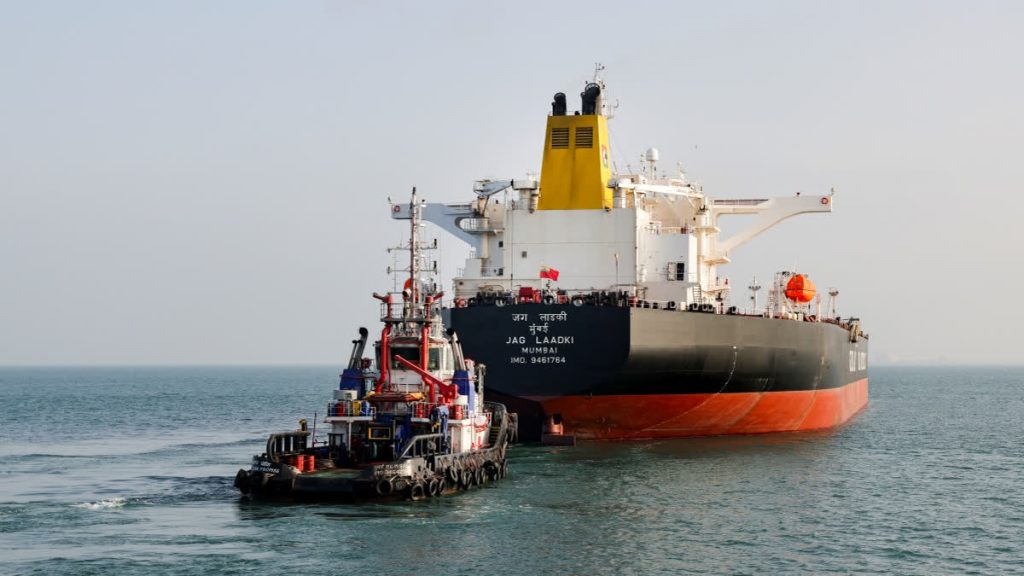 China and India still receive Gulf crude through Iran’s selective exemptions
The big Asian buyers have their own arrangements. Of the 10.23 million barrels a day of Gulf crude that passed through the strait in October, about 42 per cent went to China and 13 per cent to India. Their oil is still getting through, so they have little reason to spend political capital pushing for a settlement.
Baghdad: making do
Iraq has paid heavily. Its losses from the war and disrupted oil exports have reached $60 billion. It has reached an understanding with the United States to export oil through a shipping lane near Oman, and exports rose to about 3.5 million barrels a day in October from 2.65 million in September. For Iraq, too, a workable arrangement has taken the place of a full solution.
Why peace can wait
This is the uncomfortable logic of the moment. Each of the main players has found a way to live with the stalemate, while a real settlement would demand public concessions that none of them can easily afford. Even the partial recovery works against urgency: Gulf crude exports reached more than 80% of pre-war levels in October, which suggests that a degraded system can still function. Those who pay are mostly elsewhere: fertiliser buyers, chemical importers and growing economies far from the Gulf.
Possible paths
We offer no forecast, only three broad scenarios worth watching:
- The simmer continues. Selective passage, periodic strikes and a fixed risk premium become the norm, and supply chains adapt around them.
- A negotiated reopening. A face-saving formula, perhaps built on the Islamabad framework, lets both sides claim a win. That would probably need a trigger neither currently has.
- Escalation. A serious miscalculation, such as an attack with heavy loss of life, could break the stalemate in the wrong direction.
What this means for trade
bulk carrier loading port
At Gapuma, we follow Hormuz closely because no other stretch of water shows so clearly where global trade and finance are heading. For now, it suggests that volatility is no longer the exception but the operating environment. Customers and partners should plan for longer lead times, firmer freight and insurance costs, and sudden changes in sentiment. We will continue to keep them informed at every turn.