


Gold has lost roughly a quarter of its value since January, in the middle of a war. The explanation lies less in the Gulf than in Washington – and in a lesson first taught in 1979.
A haven that stopped behaving like one
Gold is supposed to rise as the world grows more dangerous. On the 221st day of the conflict between the United States and Iran, it is doing the opposite. Having touched a record of around $5,600 an ounce in late January, the metal now trades near $4,180 – roughly a quarter lower – and at the end of September it fell to a seven-week low.
Writing for Investing.com this week, the analyst Satendra Singh reaches for the obvious parallel: the seizure of the US embassy in Tehran in November 1979 and the 444 days that followed. The comparison is instructive, though not quite for the reason usually given.
The crisis of 1979 was a hostage standoff, not a war. Gold surged regardless, reaching $850 an ounce on 21 January 1980. Then it fell away, and went on falling. Diplomacy did not break the rally – the hostages remained in captivity for a further year. The price of money did.
The price of money
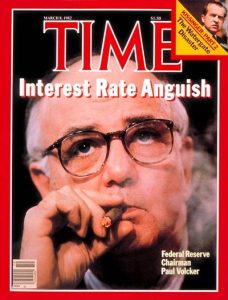
On 6 October 1979 – forty-seven years ago this week – Paul Volcker’s Federal Reserve abandoned gradualism. It set out to
control the supply of money directly and let interest rates find their own level. They found it near 20 per cent. In March 1980 President Carter added credit controls of his own, which deepened a downturn and were dismantled within months. Inflation eventually broke. So did gold.
The mechanism at work today is the same one, in a lower key. The war disrupted traffic through the Strait of Hormuz and carried Brent crude from around $73 a barrel to $118 by late April. US consumer price inflation reached 4.2 per cent in May, with energy the principal cause.
The Federal Reserve, now chaired by Kevin Warsh, responded in September by raising rates to a range of 3.75–4.00 per cent. The vote was unanimous, and 16 of its 18 policymakers expect at least one further rise before the year is out. The next decision falls on 27–28 October.
Gold pays no interest. When cash and bonds pay more, and the dollar firms, the cost of holding it rises. The conflict, in other words, is weighing on gold by way of inflation: the market is trading the central bank’s response to the war rather than the war itself.
Whose hand is on the lever?
 It is tempting to speak of a president reviving a Carter-era playbook. The phrase assumes that the playbook is his to open. For the most part, it is not.
Fiscal policy belongs largely to Congress, and a federal deficit in the region of 6 per cent of GDP leaves little room for manoeuvre in any case. What remains to the White House is persuasion, appointment and pressure – real influences, but not controls.
Monetary policy belongs to the Federal Reserve. President Trump has argued that rates should stand at 1 per cent or lower; the chairman he chose has raised them. The echo of 1979 is exact in one respect only: Carter appointed Volcker, and it was Volcker’s medicine, not Carter’s, that the economy swallowed.
The one lever that is unmistakably the President’s is the war. At a rally in Nebraska on Monday he described higher prices as “a small price to pay” and said the conflict would be over very soon. If that proves right, the reopening of Hormuz would do more to lower inflation, and with it interest rates, than any instruction to the central bank. That is a matter of diplomacy, not macroeconomic management.
What it means
 For commodity traders. Dollar funding is becoming dearer at the very moment that energy, freight and feedstock prices remain volatile. Working capital costs more, and a firm dollar bears down on buyers in import-dependent markets, not least across West and Southern Africa. In such conditions the tenor of financing, the depth of counterparty relationships and the discipline of hedging count for more than any directional view. Hormuz remains the barometer.
For investors. Gold is not a hedge against bad news as such. It protects against falling real yields and a weakening currency; it offers little shelter from a central bank intent on restoring both. Those who bought at the peak in 1980 waited nearly three decades to see that price again. The difference today is that central banks themselves remain steady buyers, which lends the metal a support it lacked then.
For savers. Higher rates are, at last, a headline in their favour. The figure that matters, however, is the real return. A deposit paying 4 per cent while prices rise by 4 per cent is merely standing still.
The lesson of 1979 is not that history repeats. It is that the crisis was brought to an end by a central banker in Washington and by negotiators in Algiers. Neither was pulling a presidential lever.
This article is commentary and does not constitute investment advice.