


7 September 2026
The Strait of Hormuz has burned again. On Saturday, Iran’s Revolutionary Guard said it had struck three oil tankers and three US-linked vessels in the waterway, in retaliation for fresh American strikes on Iranian tankers earlier the same day, including the crude carrier M/T Kylo. It is the latest exchange in a confrontation that has now run for over six months, since the United States and Israel opened their campaign against Iran on 28 February, and it comes after barely a month of relative calm.
We return to this story, as we have done repeatedly over the past six months, not simply because the flashpoint recurs, but because Hormuz has proved itself a genuine barometer for the direction of global trade and finance. Freight rates, insurance premiums, oil and gas prices, and by extension inflation expectations and interest rate decisions worldwide, all take their cue from what happens in this one stretch of water. Few single chokepoints tell you as much, as quickly, about where the global economy is heading.
The toll is no longer abstract. The crisis has claimed twenty seafarers and one port worker, with thirty-five more injured; Iran alone struck at least thirteen commercial vessels in August, including a strike on the tanker MT Sidr that killed two crew. Traffic through the Strait, which normally carries around a quarter of the world’s seaborne oil trade and close to a fifth of its liquefied natural gas, remains a fraction of its pre-crisis volume, and increasingly hard to verify: with more vessels switching off their transponders to avoid becoming targets, even Washington’s own figures on daily barrel flows are treated with scepticism by independent maritime analysts.
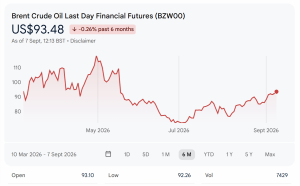
Markets have responded in the only language they know. Brent crude has posted a third straight daily gain, quoted around $79 a barrel by XTB, while broader crude benchmarks tracked by Trading Economics were up roughly nine per cent on the week and trading closer to $91. The World Bank now expects energy prices to surge 24 per cent this year, the sharpest rise since Russia’s invasion of Ukraine, and overall commodity prices to climb 16 per cent, driven by energy, fertiliser and record metal prices. None of that is contained to the Gulf: it is arriving at exactly the moment the Federal Reserve and the Bank of Japan are trying to judge whether inflation is beaten or merely resting, with Friday’s US inflation print now doing double duty as a bellwether for both monetary policy and the price of keeping ships moving through Hormuz.
Has a resolution become more plausible, or less? The honest answer is: less, for now, though not for want of trying. Delegations from Washington and Tehran did sit down in June around a memorandum of understanding meant to end the war; the Islamabad Talks in the spring produced their own short-lived ceasefire; the two governments have between them stood up a Persian Gulf Strait Authority and an Islamabad Memorandum as embryonic institutional scaffolding; and as recently as 25 August, the US Navy confirmed it had cleared the Strait’s principal shipping lane of more than a hundred suspected mines. Each of these is a genuine, if partial, achievement. But each has also been followed, within weeks, by a fresh exchange of fire, and this weekend’s strikes on tankers and US-linked vessels suggest the underlying dispute, over who controls passage through Hormuz, remains as unresolved as it was in February.
That is the real cost of stalemate: not only the lives already lost and the tankers already burned, but a global economy that cannot fully exhale. Insurers cannot fully price Gulf risk while ceasefires keep breaking. Central banks cannot fully relax while a fifth of the world’s LNG and a quarter of its seaborne oil sit hostage to one of the narrowest, most contested shipping lanes on Earth. And companies across the commodities and chemicals trade, ourselves included, cannot plan a “normal” that keeps receding by another month, then another. A durable settlement, whatever shape it eventually takes, is not simply a diplomatic nicety; it is the precondition for the world’s freight rates, feedstock costs and interest rate decisions to return to something like predictability. Until then, the bill for uncertainty keeps being paid, by shipowners, by insurers, by consumers, and by every business that trades across this most contested of waterways.
This is the latest in our ongoing coverage of the Strait of Hormuz crisis and its implications for global trade.