


Going to Ground: Why the World’s Critical Infrastructure Is Disappearing Underground
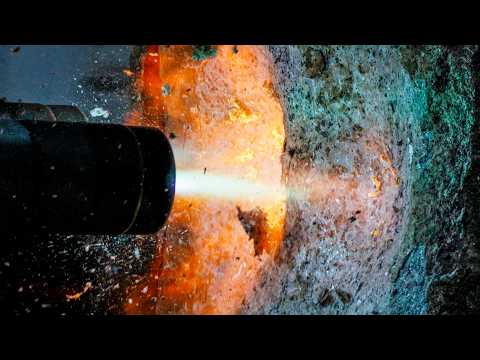
Title Image: Courtesy of EarthGrid
24 August 2026
In a Californian quarry this January, a small team of engineers watched a cigar-shaped machine come alive. Three plasma torches, mounted within a spinning head, ignited with a roar loud enough, in the words of EarthGrid founder Troy Helming, to feel “like igniting a rocket”. Within minutes the torches settled into a quieter rhythm, projecting a stream of superheated plasma at 27,000°C – hotter than the surface of the Sun – into a wall of white granite. By the end of the test, the machine had bored three metres through some of the hardest rock on Earth, clearing molten debris in what Helming describes as a controlled vortex at the tunnel face.
It is an extraordinary image, but it also serves as a useful entry point into a much broader story. After decades of resistance, driven chiefly by cost, much of the world’s critical infrastructure – power, telecommunications, data storage, even freight – is retreating beneath the surface.
A war that changed the calculus
Undergrounding is not new. Humans have buried what matters since antiquity, and modern electricity and telecoms networks have used underground cabling for generations wherever terrain, cost or urban density demanded it. What has changed is the economics – and, more urgently, the risk calculus.
Engineering firms report rising demand for burying infrastructure, and much of that shift traces directly to the war in Ukraine. Russia’s sustained drone campaign against Ukraine’s power grid, heating plants and substations has demonstrated, repeatedly and cheaply, how easily above-ground energy assets can be disabled. Research from the European Council on Foreign Relations has tracked a steady rise in drone sightings over European airports, ports and energy sites since 2020, including an incident in August 2026 in which a small explosive-laden drone was recovered near Leipzig airport in Germany. Separate monitoring by security researchers puts the number of suspected sabotage attempts against critical infrastructure across Europe, since the war began in 2022, in the dozens.
For engineering firm Joseph Gallagher, this is playing out directly in client conversations. Robbie McGoran, the firm’s head of work winning and business development, notes that countries bordering Russia have grown increasingly cautious about who is permitted near their infrastructure – and are burying assets specifically to keep them protected. It is a striking reversal: undergrounding, once viewed chiefly as a costly urban planning problem, is increasingly treated as a matter of national security.
The seabed becomes a frontier
The same logic is playing out beneath the waves. Since Russia’s invasion of Ukraine, the Baltic Sea has recorded roughly ten subsea cable and pipeline faults, according to research compiled at the University of Washington’s Jackson School of International Studies – seven of them clustered between November 2024 and January 2025 alone. Several have been linked to vessels dragging anchors across the seabed, including the Balticconnector gas pipeline, severed in October 2023, and the BCS East–West Interlink and C-Lion1 telecoms cables, disrupted within hours of one another in November 2024. Finnish, Estonian and Latvian authorities have since detained or investigated multiple vessels, though definitive attribution has often proven difficult; Finland’s own security service has cautioned against assuming every fault is deliberate sabotage.
Whatever the precise cause in each case, the response has been to dig deeper – literally. Lane Burdette, senior analyst at telecoms research firm TeleGeography, notes that submarine cables are increasingly being laid several metres beneath the seabed, and in the most fault-prone stretches, along their entire length. It is a costly, slow-moving answer, but one that appears to be reducing the rate of faults per kilometre of cable deployed.
Data’s new bunkers
If subsea cables are burrowing deeper, data centres are retreating into mountains. Alexander Taylor, senior lecturer in communications at the University of Exeter, has tracked what he terms a “data bunker boom” – a growing preference among operators for repurposed mines, caverns and Cold War shelters over conventional above-ground campuses.
The trend has genuine pedigree. Sweden’s Pionen facility, built into a former civil defence bunker beneath Stockholm, and the Iron Mountain complex in Boyers, Pennsylvania – a disused limestone mine more than 200 feet underground – have operated on this principle for years: rock offers a kind of protection that no data-centre wall can match, along with a naturally stable temperature that cuts cooling costs. Newer entrants are following suit. Trentino DataMine’s facility, carved into freshly excavated caverns 100 metres beneath the Dolomite Mountains in Italy, sits alongside spaces once used to store sparkling wine and cheese. Chief executive Dennis Bonn has argued that ninety million cubic metres of dolomite rock provide a level of protection against physical intrusion, electromagnetic interference and seismic risk that simply cannot be replicated above ground.
The limits of going underground
None of this suggests infrastructure is heading wholesale beneath the surface. Tunnelling remains expensive – sometimes several times the cost of laying cable above ground – and the engineering challenges are considerable, from releasing gases trapped in the rock to managing flooding and maintaining precision through variable geology. Progress with conventional mechanical boring is still often measured, as McGoran puts it, in millimetres per minute, which is precisely why newer approaches such as EarthGrid’s plasma-based method, which the company says can cut both time and cost dramatically compared with mechanical drilling, have attracted serious investor interest.
In Britain, the calculus still tends to favour above-ground solutions outside dense urban centres. Mark Neller, energy leader for Europe, India, the Middle East and Africa at engineering consultancy Arup, points out that Britain’s electricity system is built with considerable redundancy, meaning that installing additional above-ground circuits is often the more cost-effective route to resilience than tunnelling. London is the clear exception: the £1bn London Power Tunnels project, on which Arup worked, laid eighteen miles of cable tunnels beneath the capital precisely because urban density made any other option impractical.
Richard Little, an infrastructure policy consultant who worked on underground infrastructure planning through the 1990s, offers a useful corrective to any assumption that burying everything is the answer. Reflecting on Cold War-era bunker planning – when the threat of nuclear war made such projects a serious talking point in Western capitals – he concludes that it did not take policymakers long to establish that undergrounding everything is simply not feasible. The more productive question, in his view, is which specific facilities, such as computer chip manufacturing plants, would be genuinely difficult to replace if destroyed.
What it means for global trade
For businesses that move physical goods and materials across contested geographies, this is not an abstract engineering debate. The infrastructure now being reinforced – transmission grids, subsea cables, data centres, tunnelled freight corridors – forms the physical layer beneath every modern supply chain, including the flows of commodities and speciality chemicals that international trading businesses depend on daily.
The lessons emerging from Ukraine’s power grid, the Baltic seabed and the Dolomite Mountains point to a wider principle that extends well beyond energy and telecoms: resilience is no longer solely a matter of diversifying suppliers or shipping routes. It is increasingly a matter of the physical robustness of the infrastructure those routes and networks depend on. As drone warfare, seabed sabotage and climate volatility become recurring features of the operating environment, the organisations that plan for the durability of the ground beneath their supply chains – quite literally, in some cases – are the ones best placed to keep moving when others cannot.
The rock-melting machine in that Californian quarry is, in that sense, a small but telling signal of where global infrastructure thinking is heading: down, and with increasing urgency.
Source: adapted from Chris Baraniuk, “The critical tech staying safe by going underground”, BBC News, 19 August 2026. Read the original article at www.bbc.co.uk/news/articles/c20ydrndr0wo.