


By: Phume Mazibuko, Operations Associate
3 November 2026
For almost half a century, one country has had the pure-ethanol car to itself. Brazil built an entire motoring culture around fuel distilled from sugarcane, while the rest of the world treated ethanol as something to stir into petrol in modest quantities. Last week, that changed. India, the world’s third-largest car market, wrote E100 into its vehicle rules. The pioneer finally has company, and the latest arrival is a very large one.
On 23 October, India’s Ministry of Road Transport and Highways amended the Central Motor Vehicles Rules to recognise E100 – fuel that is almost entirely ethanol – for certified flex-fuel vehicles. The notification, G.S.R. 911(E), appeared in the official gazette on 26 October and adds E100 alongside E85 in the emission and testing standards. It follows a draft published for consultation in April.
The wording is deliberately narrow. High-ethanol fuels “shall be used in the vehicles designed by the original equipment manufacturers” as flex-fuel vehicles. For India’s existing motorists, nothing changes. Cars built for today’s E20 petrol cannot simply switch to pure ethanol, and owners are not being asked to convert anything. What has changed is that carmakers now have a clear route to certify flex-fuel models for sale.
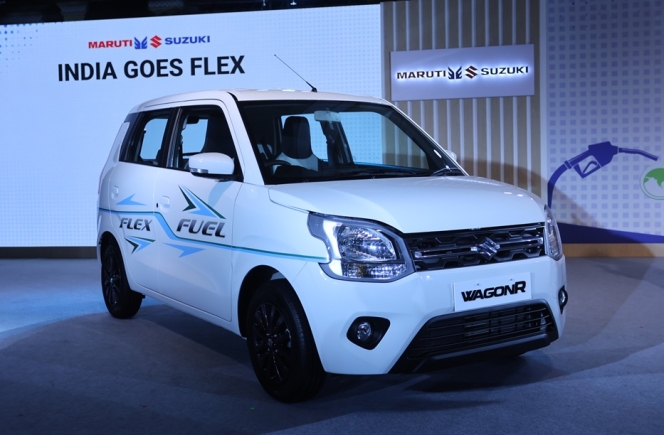
Some are already on the move. Maruti Suzuki launched the Wagon R Flex Fuel, which can run on anything from E20 to E100, in June. Toyota, Tata Motors and Hyundai are developing their own. Road transport minister Nitin Gadkari, who has championed ethanol for years, has suggested an all-ethanol car could bring fuel costs down to around Rs 25 a litre. What the notification does not do is set a date for E100 to reach the forecourt.

Maruti Suzuki’s Wagon R Flex Fuel – India’s first flex-fuel passenger car
India does not have to look far for a template. Brazil launched its national ethanol programme in 1976, in the aftermath of the first oil shock, and spent the next three decades building the distilleries and distribution network to support it. The decisive moment came in 2004, with the arrival of flex-fuel cars that let drivers choose petrol, pure ethanol or any blend of the two at the pump. Today flex-fuel vehicles account for more than 85% of new light vehicle sales in Brazil and over 80% of the fleet, and pure hydrous ethanol is sold at almost every filling station.
The pioneer has not stood still. On 14 July, Brazil’s National Energy Policy Council raised the mandatory ethanol content of ordinary petrol from 30% to 32% for 180 days, citing volatility in global oil markets. The move has been challenged in the courts by federal prosecutors, who argue that the testing behind it was designed for E30. The Ministry of Mines and Energy is unmoved, insisting that E32 is technically viable and safe for vehicles.
Brazil also shows the limits of the model. Its flex-fuel drivers are ruthlessly practical: they buy whichever fuel is cheaper. In February, only around a quarter of them were filling up with pure ethanol.
 Sugarcane harvest in São Paulo state, the heartland of Brazilian ethanol
 Sugarcane harvest in São Paulo state, the heartland of Brazilian ethanol
The timing is no coincidence. With the Strait of Hormuz still largely closed and crude prices volatile, governments everywhere are taking a harder look at fuel they can grow at home. Brazil cited exactly that volatility when it moved to E32. In India, officials have been explicit that flex-fuel vehicles reduce the country’s exposure to fossil-fuel import risks – no small matter for a nation that imports most of its oil.
Others are moving too, although most are adjusting blends rather than embracing pure ethanol. The US House of Representatives passed a bill in May to allow E15 to be sold year-round, though it still awaits the Senate. Paraguay already runs E30 as standard, and Thailand sells E20 and E85 alongside its mandatory E10. Indonesia plans to introduce E10 from 2027 and move towards E20, although supply constraints have already pushed its timetable back once. Japan is taking a more measured path, targeting E10 by 2030 and E20 by 2040. Europe remains the outlier, capping crop-based ethanol at around 7% of transport energy.
The picture, then, is one of a broad shift towards ethanol, with Brazil out in front and India now positioned to become the second country where pure ethanol is an everyday pump fuel.
For Gapuma, this is not a distant policy story. Biofuels and ethanol are one of our core sectors: we source fuel-grade, industrial and extra neutral alcohol from leading distilleries and deliver it to blenders, distributors and oil companies, in anything from drums to full vessel cargoes. We have worked with Indian ethanol for well over a decade, supporting the movement of product from Indian distilleries into the Middle East and Africa, and our sourcing is ISCC certified.
India’s decision matters to us in two ways. First, it signals rising domestic demand for ethanol in one of the world’s most important producing countries, which will shape availability and pricing for everyone who buys from it. Second, it reinforces a trend we see across our markets, from West Africa to South America: governments treating home-grown fuel as a matter of energy security rather than simply an environmental gesture. Supply chains built around ethanol will need reliable sourcing, careful quality control and the logistics to move product where it is needed. That is the work we do every day.
Brazil’s experience suggests that three things will decide whether India follows it all the way. The cars need to arrive in volume, and India’s first flex-fuel passenger car only went on sale in June. Ethanol needs to stay cheaper than petrol at the pump, because drivers will not pay a premium for principle. And distillery capacity has to keep pace, or India risks exchanging imported oil for imported ethanol.
Brazil took almost three decades to move from its first ethanol programme to a flex-fuel fleet. India has put its legal framework in place six months after publishing the draft. The rules are the easy part. Whether the cars and the fuel follow is the real story, and one we will be following closely.