


14 May 2026
By: Shahab MOSSAVAT
When Donald Trump first touched down in Beijing in November 2017, Xi Jinping laid on the full theatre of imperial hospitality: a private dinner in the Forbidden City, a parade through Tiananmen Square, and the announcement of $250 billion in business deals – a figure so grand it dwarfed the entire annual GDP of West Virginia, where one of its headline memoranda of understanding was supposedly centred. Almost none of it materialised. The symbolism, however, was exquisitely chosen. China was telling the world – and telling Trump – who was truly in charge.
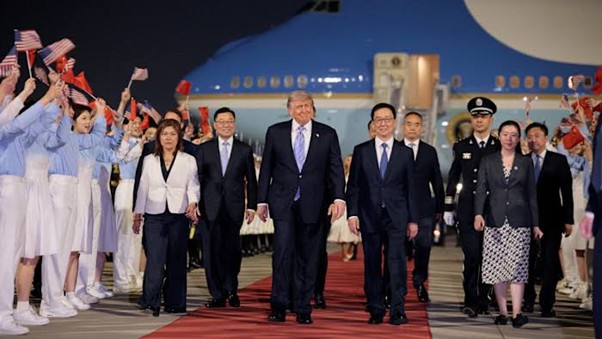
Nine years on, the pageantry at Beijing Capital International Airport on Wednesday – the honour guard, the schoolchildren chanting in Mandarin, the skyscrapers lit with welcoming characters – carried an almost identical message, delivered with rather more pointed subtlety. Air Force One landed, and a US president who had spent his first term threatening to break China, and his second term actually trying to, stepped onto a red carpet laid by a nation that had absorbed his blows, weaponised its advantages in response, and emerged from the encounter structurally stronger.

Donald Trump is greeted at Beijing airport by Chinese Vice President Han Zheng
The shift in the bilateral power dynamic is not subtle. It is measurable, documented and, for Washington, deeply uncomfortable.
When Trump arrived in 2017, the United States still held most of the conventional cards: it was the world’s pre-eminent consumer market, the anchor of the dollar-denominated global financial system, and the unchallenged custodian of the rules-based international order. China was formidable but still, in important respects, dependent – on American technology, American markets and American acquiescence. Trump’s instinct, brutal in its simplicity, was to exploit that dependency through tariffs. What he did not foresee was that a decade of patient strategic investment had quietly altered the underlying geometry.
Consider the arithmetic of the current summit. Trump arrives in Beijing wanting concessions: market entry for American companies, Chinese purchases of Boeing aircraft and US soybeans, a softening of rare earth export restrictions that brought his own industrial economy to the edge of a supply crisis. Xi, by contrast, wants stability – time to consolidate a technological and industrial position that has already, by most independent assessments, reached escape velocity. The asymmetry is telling. One leader is shopping for wins to take home to voters ahead of bruising midterm elections. The other is managing a civilisational project measured in decades. Scott Kennedy, senior adviser and trustee chair in Chinese Business and Economics at the Centre for Strategic and International Studies in Washington, put it with characteristic precision in CNBC on the day the summit opened: “China comes into this meeting far more confident than in 2017, when it feared even a small rise in US tariffs. In the last year, Xi has been able to push back and neutralise much of Trump’s actions.”

2017 v 2026: Change in Body Language?
Central to China’s structural advantage is its commanding position in the global shipping and logistics system – a dominance so comprehensive that it shapes the price of practically everything that moves by sea. By mid-2024, China had invested in ports in 16 of the top 20 nations for shipping connectivity. Roughly 27 per cent of global container trade now passes through terminals partly or wholly owned by Chinese or Hong Kong-based companies. In 2024 alone, China’s largest state-owned shipbuilder produced more commercial tonnage than the entire United States shipbuilding industry has delivered since the Second World War. Shanghai handled 51.5 million TEUs in 2024, making it the world’s busiest port – five times the throughput of Los Angeles and Long Beach combined. When China flexes its position in containerised freight, it is not merely adjusting a commercial variable. It is moving a lever that governs global commodity pricing across industries from automotive parts to pharmaceuticals, from agricultural produce to consumer electronics. The United States, which conducts the overwhelming majority of its trade by sea, sits downstream of that lever.
Underpinning this logistical supremacy is a strategic energy architecture that took shape long before Trump’s tariff wars began. China’s early and consistent investment in Iranian crude – formalised in the 25-year, $400 billion cooperation agreement whose foundations Xi Jinping himself proposed during a 2016 visit to Tehran – secured access to oil trading at an $8–10 discount per barrel below global benchmarks. While Western economies lurched from one energy shock to the next, buffeted by sanctions regimes and geopolitical crises they themselves often authored, Beijing was buying Iranian crude at predictable, heavily discounted rates through independent refiners insulated from direct sanction exposure. More broadly, Xi’s decade-long programme of energy self-sufficiency – wind, solar, hydropower, domestic drilling and diversified import partnerships – has positioned China to weather disruptions that send other economies into crisis. The current US-Israel war against Iran, which has blockaded the Strait of Hormuz and sent global energy prices spiralling, is a case in point. China’s energy fortress, as analysts at Columbia University’s Centre on Global Energy Policy have noted, appears to be passing its sternest test. That cannot be said of the United States.

Yangshan: The world’s busiest container port handling more than 50 million TEUs annually
The technological transformation is perhaps the most significant shift of all. China is no longer, in any meaningful sense, the cheap-labour assembly floor of the global economy. Its “Made in China 2025” industrial strategy has delivered on its core promises with a thoroughness that has alarmed Western analysts. China now leads the world in industrial robotics installations, dominates the clean technology supply chain from lithium batteries to solar panels, and – with DeepSeek’s R1 model launching in early 2025 to international astonishment – has demonstrated serious, applied artificial intelligence capability that challenges American primacy in what was supposed to be a US-led domain. In rare earths, which sit at the chokepoint of every advanced technology from fighter jets to electric vehicles to AI semiconductors, Beijing controls 85–90 per cent of global processing capacity and effectively 99 per cent of heavy rare earth refining. When Xi threatened to restrict rare earth flows in April and October 2025, Trump retreated rather than escalate. That single episode encapsulates the altered balance of power more precisely than any diplomatic communiqué.

China holds a predominant position on rare earths
China’s non-interventionist posture – its studied refusal to take sides in conflicts from Ukraine to the Middle East – has, paradoxically, amplified its global influence. While the United States has spent two decades and incalculable treasure on wars of choice, China has built ports, laid railway lines, financed infrastructure across the Global South through the Belt and Road Initiative and accumulated the kind of patient, compound-interest influence that military power cannot replicate. Xi’s watchword has been strategic endurance. The phrase sounds passive. It is not. It describes a calculated willingness to absorb short-term pressure – including the most punishing tariff barrage in modern history – in the confidence that structural advantage compounds over time.
COVID-19 accelerated many of these trajectories. The pandemic exposed the fragility of Western supply chains with brutal efficiency. It revealed that the world’s capacity to manufacture personal protective equipment, pharmaceuticals and critical components resided overwhelmingly in China. It demonstrated that American economic resilience, predicated on the just-in-time logic of globalisation, had been quietly hollowed out. China, meanwhile, controlled its outbreak earlier, maintained industrial output and emerged from the pandemic years with its manufacturing base intact and its export market share expanded.
Trump’s “Liberation Day” tariffs of 2025, which pushed duties on Chinese goods past 140 per cent, were supposed to deliver a knockout blow. Instead, as CNN reported from Beijing this week, China’s economy expanded by a better-than-expected five per cent in 2025, extending into the first quarter of 2026, as Chinese exporters successfully pivoted to markets outside the United States. The Global South – where China has been methodically building relationships for two decades – absorbed much of the redirected trade. The tariffs hurt. They did not break.

Pax Sinica?
The contrast with 2017 is, in the end, stark and structural rather than merely atmospheric. Then, Trump came to Beijing as a disruptor confident in American leverage. Now, he arrives as a president who needs China to agree to buy Boeing aircraft, to ease rare earth restrictions that are throttling American manufacturing, and potentially to help broker a ceasefire in an Iranian conflict that has spiralled beyond Washington’s control. As a retired Chinese colonel told the New York Times last week, Trump had originally intended to arrive “with the air of a swift victor.” The war in the Middle East, and the structural realities of American overextension, had “significantly diminished” his capacity to project either strength or the threat of escalation.
Xi Jinping has long told his party cadres that “the East is rising and the West is declining” and that “time and momentum” are on China’s side. The 2026 Beijing summit is not proof that he is right about everything. Li Cheng, founding director of the Centre on Contemporary China and the World at the University of Hong Kong, cautioned in the South China Morning Post on the summit’s opening day that whilst the meeting was “extremely important to arrest the downward spiral of relations between the two countries,” a summit alone “would not be enough to change the overall structure of ties, which had been fraught for years.” He is right, on both counts. But it is powerful evidence that, on the question of which great power has used the past decade more wisely, history is beginning to render its verdict.